Private Aircraft Detailing: What Every Pilot Should Know
An overview of private aircraft detailing for owners and pilots in the Boise area. From exterior wash to interior care, understand what professional aircraft detailing involves.
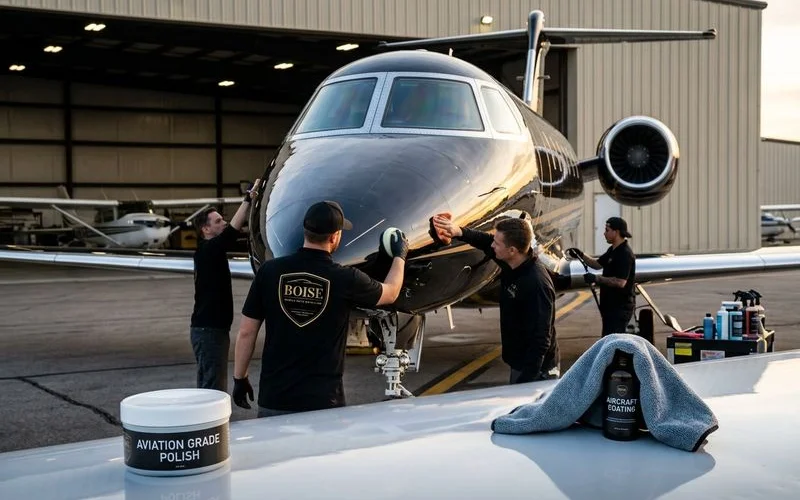
Some of us look at a plane and see a machine; we see a fragile ecosystem of aluminum, composite, and acrylic that is constantly fighting the environment. Owning a private aircraft offers a level of freedom that is hard to match, but it also comes with a unique set of responsibilities. We often see owners invest heavily in avionics and engine upgrades while overlooking the one maintenance task that protects the airframe itself.
You know how tempting it is to treat your aircraft like a large car, grabbing a bucket of soap and a sponge on a sunny Saturday? From our experience, that mindset is where the most expensive damage begins. Aircraft detailing isn’t just about aesthetics; it is a critical form of corrosion control mandated by physics and regulated by safety standards.
We are going to break down why the chemistry of aviation cleaning matters, the specific risks to your airframe, and the exact protocols required to keep your investment airworthy.
Why Aircraft Detailing Is Different
Aircraft detailing is fundamentally different from automotive care due to the materials involved and the consequences of failure. A car with a rusty fender is an eyesore; an aircraft with a corroded spar is a safety hazard that can ground you indefinitely. We approach every aircraft with the understanding that improper cleaning can cause damage just as effectively as a mechanical failure.
High-desert environments like the Boise area present a perfect storm of challenges for general aviation. Our high-altitude sun intensifies UV radiation, accelerating paint oxidation, while local temperature inversions trap pollutants that settle on airframes. The seasonal dust and agricultural fallout in the Treasure Valley create a chemical cocktail that, if left sitting, eats into paint and aluminum.
The Boeing D6 Standard
In the automotive world, you can use almost any soap without catastrophic results. In aviation, we strictly adhere to standards like Boeing D6-17487. This specification ensures that a cleaning product will not craze plastics, soften paint, or corrode aluminum. If a bottle doesn’t say “Boeing D6 Certified” or meet Mil-Spec requirements, it does not touch your aircraft.
These tests are rigorous for a reason. They specifically check for sandwich corrosion, where cleaner gets trapped between metal sheets, and hydrogen embrittlement, which can snap high-strength steel parts. Using a non-compliant cleaner might save five dollars today but could cost you a wing spar inspection later.
Exterior Detailing Considerations
Approved Products Only
Using the wrong cleaner is the most common mistake we see owner-operators make. Many household cleaners, such as the standard formulation of Simple Green, are highly alkaline (often pH 9.0 or higher) and contain citrus solvents like d-Limonene. These ingredients are active enemies of aviation metals.
We see cases where these cleaners trigger hydrogen embrittlement in high-strength aluminum alloys like 7075-T6. This process weakens the metal from the inside out, leading to microscopic cracking that is invisible until a part fails under stress.
Our team only uses aviation-specific cleaners like Simple Green Extreme (Aircraft Precision Cleaner), Carbon X, or Aero Cosmetics Wash Wax ALL. These formulas are pH-neutral and tested for aluminum safety. They lift dirt without reacting with the metal substrate or stripping away the protective Alclad layer found on many airframes.
Paint and Surface Types
Aircraft paint systems, typically polyurethane, are chemically different from automotive clear coats. They are designed to flex with the airframe during flight and temperature changes. We adjust our polishing techniques to account for this flexibility, ensuring we remove oxidation without thinning the paint to dangerous levels.
Many aircraft also feature composite materials or fabric skins that require entirely different care. A compound designed for aluminum can permanently damage a composite weave or dissolve the glues used in fabric aircraft.
Leading Edges and TKS Panels
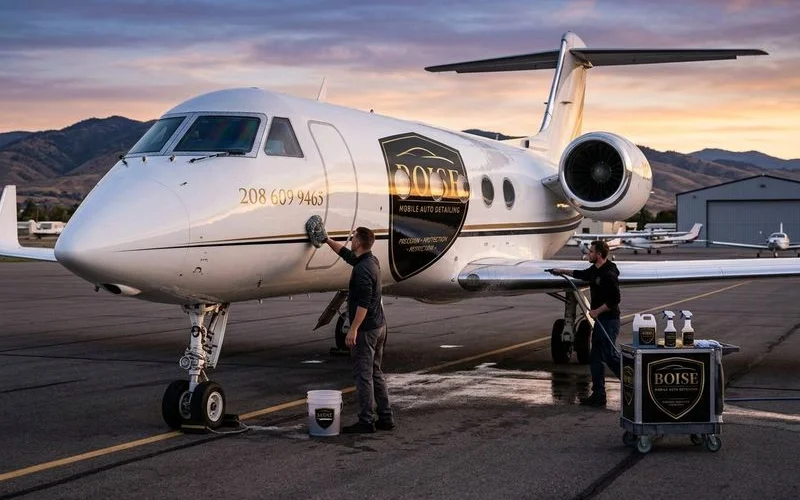
The leading edges are your aircraft’s first line of defense against erosion, but they are also where we see the most significant maintenance errors. If your aircraft is equipped with TKS “weeping wing” ice protection, you must never apply wax to the porous titanium panels. Wax will clog the laser-drilled holes, rendering your de-icing system useless.
Replacing a clogged TKS panel on a Cirrus or Bonanza can easily exceed $5,000 per panel in parts and labor. We clean TKS panels using only approved fluids (like TKS 406B) or mild soap and water, scrubbing in a chordwise direction (with the airflow). This technique removes bug splatter—which is acidic and will etch the metal—without forcing debris deeper into the pores or damaging the membrane.
Belly and Exhaust Staining
The underside of an aircraft is a magnet for exhaust soot and oil, which form a corrosive paste when mixed with moisture. On turbocharged piston aircraft burning 100LL Avgas, this exhaust deposit contains Lead Bromide, a byproduct of the combustion process.
When this residue mixes with water, it can form acidic compounds like hydrobromic or sulfuric acid. We use specialized aviation degreasers to emulsify this sludge so it can be wiped away without heavy scrubbing. Regular removal is critical; if these acidic deposits are allowed to sit, they will eventually stain the paint permanently and begin pitting the aluminum skin beneath.
Interior Detailing Considerations
Instrument Panel and Avionics
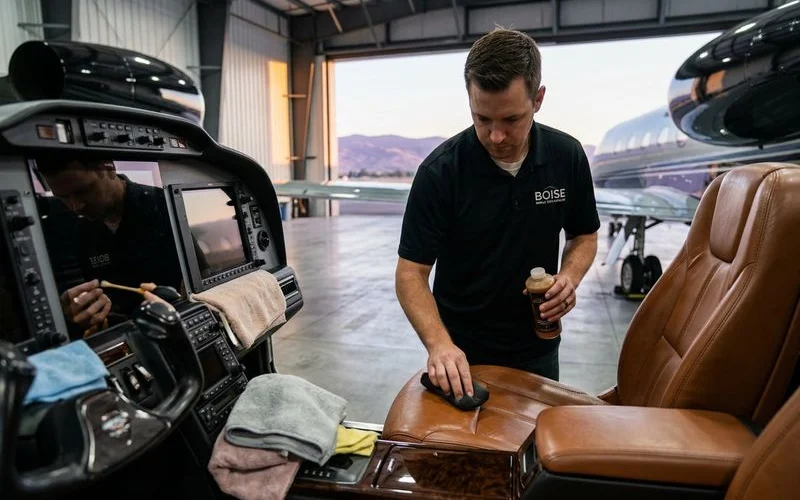
The avionics stack is the most expensive square footage in your aircraft, and proper interior detailing requires understanding that it is incredibly sensitive to moisture. We never spray liquid cleaners directly onto an instrument panel. Instead, we spray a specialized anti-static cleaner onto a microfiber cloth outside the aircraft, then gently wipe the bezel and buttons.
Modern glass cockpits (Garmin G1000, Avidyne, etc.) feature screens with delicate anti-reflective (AR) coatings. Standard glass cleaners with ammonia will strip this coating, leaving a patchy, glare-prone mess. A replacement display unit for a system like a G1000 NXi can cost upwards of $15,000 on the exchange market. We use only products specifically formulated for avionics screens, such as Clear View or iCloth, to preserve optical clarity.
Upholstery and Carpet
Corrosion often starts from the inside out, specifically under the floorboards. We see this happen when carpet cleaning is done too aggressively with too much water. The moisture seeps through the backing and sits on the aluminum floor structure, trapped with no airflow.
Our process involves low-moisture extraction methods that clean the fibers without soaking the backing. For leather surfaces, we use conditioners that meet burn certification requirements (FAR 25.853), ensuring the material remains supple without adding flammability risks. Household detergents can leave residues that technically void your interior’s fire safety certification.
Headliner and Sidewalls
Aircraft headliners are often suspended or glued with adhesives that are sensitive to heat and moisture. Aggressive scrubbing can cause the fabric to delaminate or sag. We use a dry-cleaning sponge technique or very light misting to lift stains without saturating the material.
Window and Windshield Care
The Vertical Wipe Rule
Aircraft windshields are typically made of acrylic (Plexiglas) or polycarbonate, both of which are far softer than automotive glass. The most critical rule we follow is to always wipe vertically (up and down), never in circles.
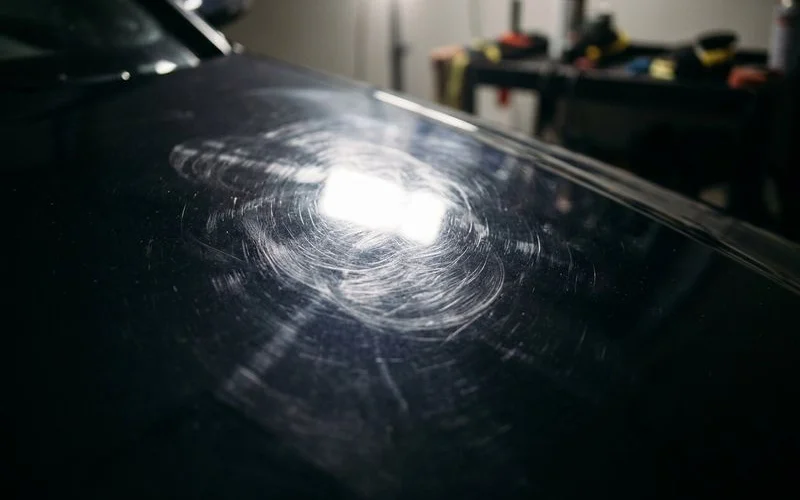
If a tiny piece of grit gets caught in the cloth while wiping in a circle, it creates a swirling scratch pattern. In direct sunlight, this “halo” effect can completely obscure a pilot’s forward vision. A vertical scratch, by comparison, is much less likely to catch the light and blind you during final approach.
Avoiding Chemical Damage
Never use ammonia-based cleaners like Windex on aircraft windows. Ammonia causes “crazing,” which looks like a web of tiny cracks within the plastic itself. Once crazing occurs, the structural integrity of the window is compromised.
Replacing a crazed windshield on a pressurized aircraft like a Beechcraft Baron or Piper Malibu often costs between $3,500 and $7,000. We use dedicated products like Prist Acrylic, Plastic & Glass Cleaner or 210 Plastic Cleaner that feed the plastic while cleaning it.
Frequency and Scheduling
The cost of repainting a single-engine aircraft has risen sharply, now ranging from $20,000 to over $30,000 for high-quality work in 2026. Making preservation a financial priority is the only logical choice. We recommend a schedule based on how your aircraft is stored and flown.
| Aircraft Status | Recommended Frequency | Key Focus Areas |
|---|---|---|
| Active (10+ hrs/mo) | Monthly Wash | Bug removal on leading edges; windshield care to prevent scratches. |
| Hangar Stored | Quarterly Detail | Dust removal; interior conditioning to prevent leather from drying out. |
| Tie-Down / Outdoor | Monthly Exterior | Bird dropping removal (highly acidic); UV protection for paint and plastics. |
Tie-down aircraft in Idaho face the harshest conditions. The combination of intense summer sun and winter de-icing chemicals means these aircraft require the most aggressive protection strategy to prevent paint failure.
Choosing an Aircraft Detailing Provider
When vetting a detailer, ask specifically about their insurance. A standard business liability policy often excludes “aircraft in care, custody, and control.” You need to verify they carry Hangar Keepers Insurance, which specifically covers damage to an aircraft while it is being worked on.
We also suggest asking about their training regarding static ports and pitot tubes. A detailer who doesn’t know to tape off these sensitive sensors can cause an airspeed or altitude failure on your next flight.
- Ask: “What specific products do you use for aluminum safe cleaning?” (Look for Boeing D6 or Mil-Spec references).
- Ask: “How do you handle TKS panels?” (Answer should be “No wax”).
- Ask: “Do you wipe windows in circles or straight lines?” (Answer must be “Vertical/Straight lines”).
Aircraft detailing requires a level of care and knowledge that goes beyond standard detailing expertise. The investment in proper maintenance protects not just the appearance but the structural integrity and safety of your aircraft.
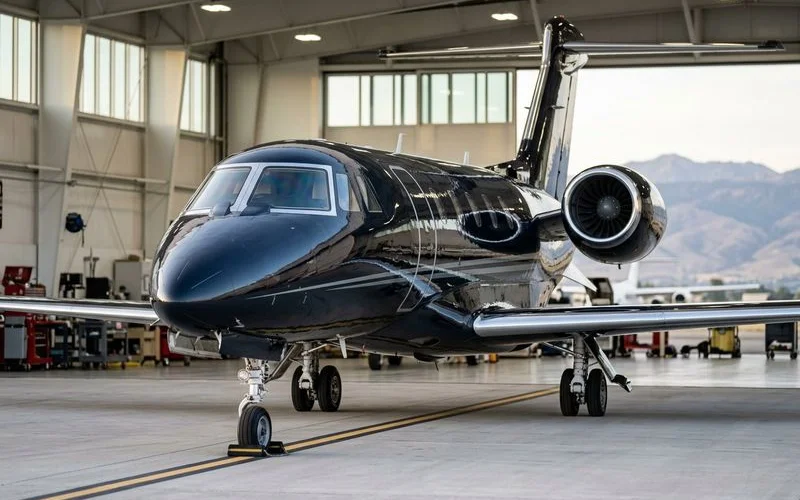
Boise Mobile Auto Detailing Team
Professional detailing specialists serving Boise and the Treasure Valley.