Is Ceramic Coating for Boats Worth It? Marine Protection Explained
Evaluating the benefits and costs of ceramic coating for boats in Idaho. Learn how marine ceramic coating compares to traditional wax and sealant for boat protection.
The Case for Marine Ceramic Coating
You know how that fresh gelcoat shine seems to disappear by July, no matter how much you wax in May?
We see this frustration every season in our shop.
Marine-grade ceramic coatings have evolved well beyond their automotive origins to solve this specific problem.
Manufacturers have formulated these coatings specifically for the unique expansion and contraction of boat surfaces.
For Idaho boat owners contending with high-altitude UV exposure and mineral-rich water, the question of whether this boat detailing protection is worth the investment deserves a hard look.
We intend to break down the real data so you can decide if the upfront cost makes sense for your vessel.
The short answer is that marine ceramic coating provides genuine, measurable benefits.
But you need to understand exactly what you are paying for to avoid disappointment.
What Marine Ceramic Coating Does
UV Protection and The “Elevation Effect”
Idaho’s high-altitude sun is arguably the single biggest threat to your boat’s gelcoat.
UV radiation attacks the cross-linking in the gelcoat’s resin, creating “free radicals” that break down the surface.
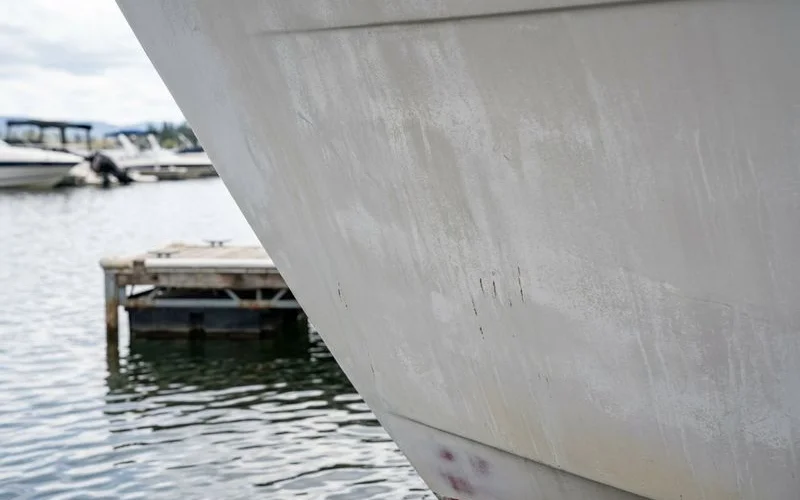
This chemical reaction causes the chalky, oxidized finish that ruins a boat’s value.
We have found that at higher elevations, UV intensity increases by roughly 10% for every 3,000 feet of altitude.
A boat sitting on a trailer in McCall or cruising Lucky Peak receives significantly more damaging radiation than a boat at sea level.
Marine ceramic coating creates a semi-permanent, UV-resistant shield that blocks this radiation.
The difference is particularly noticeable on colored hulls, which are notorious for fading within a single season.
A professional-grade coating maintains color depth and gloss for one to three years.
Hydrophobic Performance
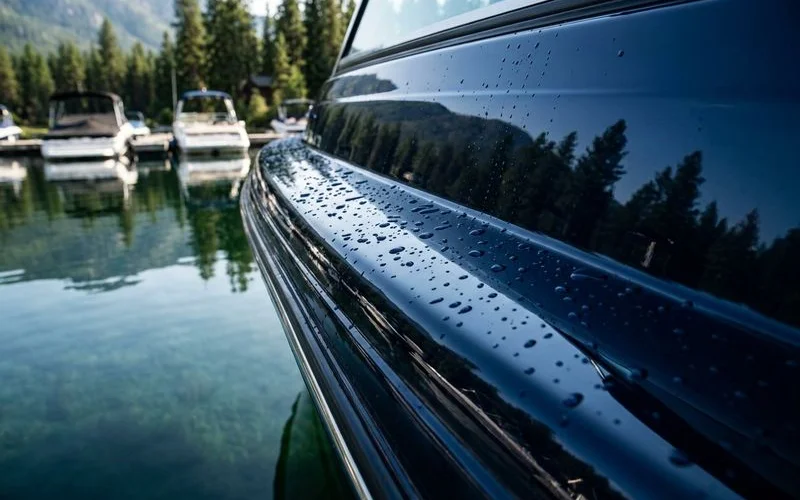
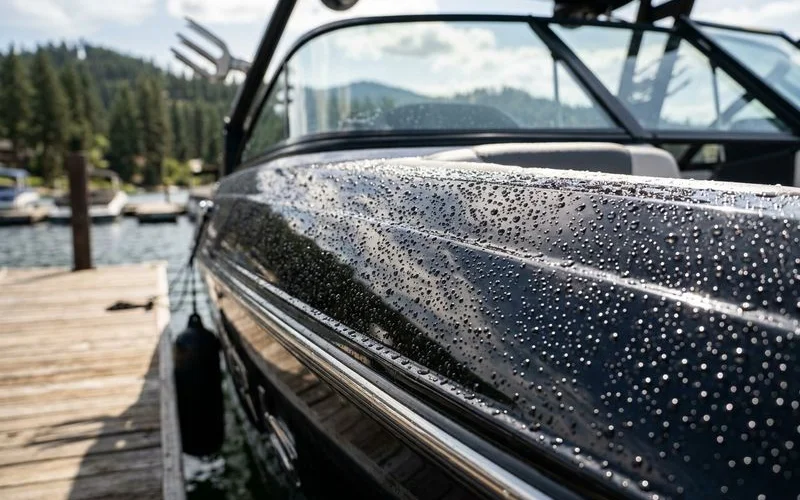
A coated hull sheds water more effectively than bare gelcoat or wax.
Technicians call this the “contact angle,” and top-tier marine coatings like IGL Ecocoat Arcane or System X achieve water contact angles exceeding 105 degrees.
Water that sheets off the surface takes contaminants with it.
This “self-cleaning” effect drastically reduces the buildup of the stubborn waterline stains and algae common in our local reservoirs.
For boats used in mineral-rich waters like Lake Lowell or Anderson Ranch, this means far less aggressive scrubbing is needed after a day out.
The hydrophobic effect also offers a slight performance advantage.
A cleaner hull reduces drag, which can translate to marginally improved fuel efficiency and top speeds.
These gains are modest compared to the cleaning benefits, but they are a welcome bonus.
Significantly Easier Maintenance
This is where most of our clients find the real return on their investment.
A ceramic-coated boat transforms the post-trip cleanup from a chore into a quick rinse.
Dirt, salt, bird droppings, and organic residue release from the surface with minimal agitation.
We often tell clients that the goal is to retire their heavy-duty stiff brushes and acid-based cleaners.
For weekend boaters in the Treasure Valley who want to maximize their time on the water, this ease of maintenance changes the ownership experience.
How It Compares to Traditional Marine Protection
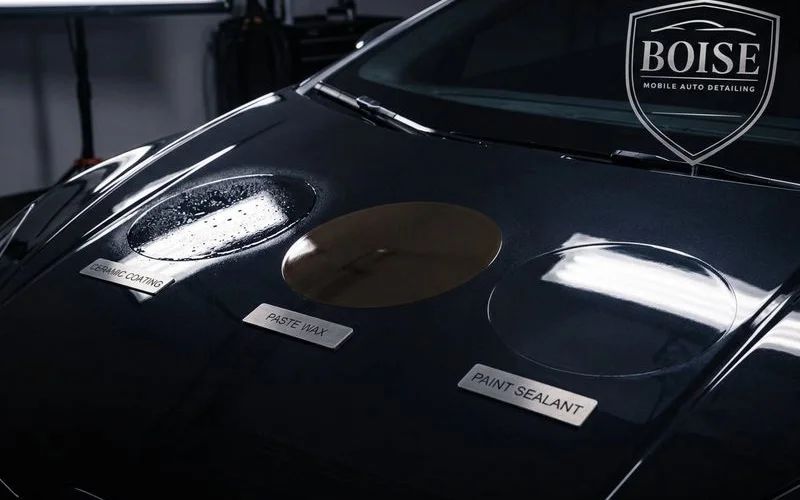
We have broken down the performance metrics to help you visualize the differences between the three main protection methods.
| Feature | Carnauba Wax | Polymer Sealant | Marine Ceramic Coating |
|---|---|---|---|
| Durability | 3-4 Months | 6-9 Months | 18-36+ Months |
| UV Resistance | Low | Moderate | High |
| Heat Tolerance | Low (Melts >180°F) | Moderate | Extreme (Up to 1200°F) |
| Self-Cleaning | Low | Moderate | High (Hydrophobic) |
| Cost (Initial) | Low | Medium | High |
Marine Wax
Traditional marine wax provides basic UV protection and water repellency for approximately three to four months.
For a boat used regularly during Idaho’s May through September boating season, this means at least two to three wax applications per year.
You must also factor in a final application before winter storage to protect the hull during the off-season.
The labor involved in waxing is substantial, as even a modest 20-foot boat requires several hours of application and buffing.
Over a three-year period, the cumulative time and product cost of repeated wax applications often approach the price of a single ceramic coating.
Marine Sealant
Synthetic sealants offer improved durability over natural waxes.
They typically last six to nine months because their synthetic polymers bond more tightly to the gelcoat.
These products provide better UV protection and stronger hydrophobic properties than wax.
Sealants reduce the frequency of reapplication but still require attention at least once or twice per boating season.
Marine Ceramic Coating
Professional marine ceramic coatings last one to three years.
Some premium products even carry warranties for up to five years when maintained by a certified installer.
The initial application is more expensive because it utilizes liquid quartz (SiO2) or Silicon Carbide (SiC) technology.
However, the long-term protection and reduced maintenance make it the most cost-effective option when measured over the coating’s lifespan.
The Application Process
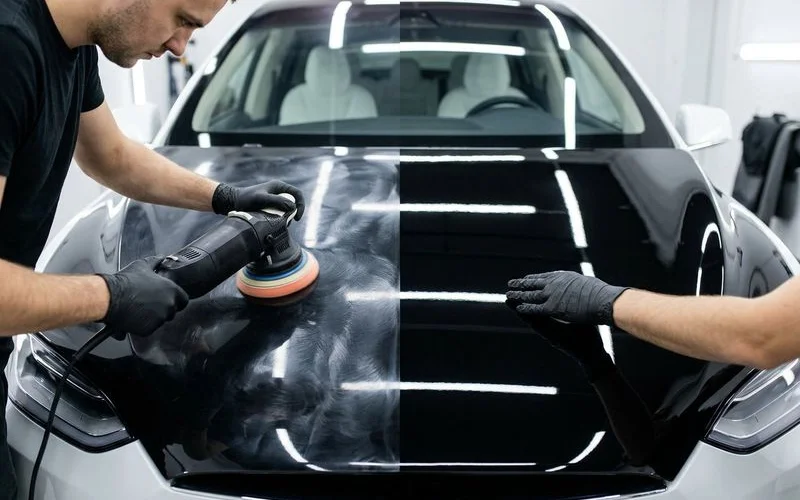
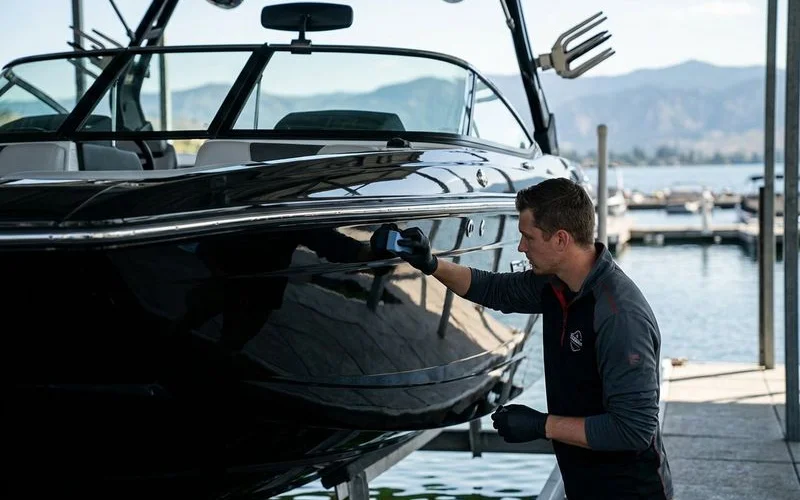
Marine ceramic coating application follows a similar process to automotive coating but on a much larger scale.
The surface must be surgically clean and decontaminated before the coating can bond properly.
We spend about 70% of the total job time just on preparation.
For boats with existing oxidation, this means “correcting” the gelcoat with compounds and polishes to restore a mirror-like finish through paint correction before we even open the coating bottle.
Curing and Environment
The coating is applied in thin, even layers using a cross-hatch pattern to ensure full coverage.
Manufacturers require specific humidity levels and cure times, which are typically longer than those for cars.
The boat must remain dry during this critical curing period.
In the Boise area, scheduling application during a stretch of dry, moderate weather is vital if you don’t have a climate-controlled facility.
The entire process for a 20-foot boat typically requires one to two full days.
This includes the decontamination wash, machine polishing, surface prep wipe-down, and the actual coating application.
Where Marine Ceramic Coating Falls Short
Transparency about limitations is important for setting realistic expectations.
It Does Not Replace Antifouling
Ceramic coating is not a substitute for bottom paint on boats that stay in the water for weeks at a time.
While the slick surface provides some resistance to algae, it lacks the biocides found in dedicated antifouling paint.
For boats kept on trailers and launched for day use, this is less of a concern.
This usage pattern is common among Boise-area boaters who dry-dock their vessels.
It Does Not Prevent Impact Damage
Dock rash, anchor chain scratches, and impact damage from floating debris are physical forces that no liquid coating can stop.
The coating acts as a sacrificial layer that may reduce the severity of very minor swirls.
However, it is not a force field against rocks, metal docks, or careless handling.
Most marine coatings are rated 9H on the pencil hardness scale, which is hard but certainly not invincible.
Maintenance Is Still Required
A coated boat still needs regular rinsing after each outing.
You must also wash it periodically with a pH-neutral marine soap to keep the hydrophobic properties active.
The coating reduces the effort involved but does not eliminate the need for care.
Neglecting this simple maintenance allows contaminants to mask the coating, degrading its performance over time.
Cost Analysis for Idaho Boat Owners
The value proposition of marine ceramic coating depends on your specific usage and ownership plans.
The Frequent User Scenario
For boats that see regular use during the season, ceramic coating typically delivers a positive return on investment.
This holds true if you store the boat on a trailer and plan to keep it for at least three years.
The ROI comes from saving 20-30 hours of labor over three years, plus the elimination of wax costs.
The Occasional User Scenario
For boats used only a few times per season, the math is different.
A quality marine sealant applied once in spring may provide adequate protection for a lower upfront cost.
However, the gelcoat preservation benefits of ceramic coating still apply regardless of how often you launch.
The Best Time to Invest
The strongest financial case for ceramic coating is on newer boats with gelcoat in good condition.
Protecting the surface before oxidation begins is always cheaper than paying for heavy correction later.
If you are purchasing a new boat or have recently had your gelcoat restored, locking in that finish now maximizes your value.
We generally see that professional marine coating packages in 2026 start around $100 to $150 per linear foot, depending on the level of polishing required.
Making the Decision
Marine ceramic coating is a proven technology with verifiable benefits for Idaho boat owners.
It is not the right choice for every single boat or budget.
But for those who value their boat’s appearance and want to stop spending their weekends waxing, it is a smart move.
It remains the most effective protection available for the investment you have made in your vessel.
Boise Mobile Auto Detailing Team
Professional detailing specialists serving Boise and the Treasure Valley.